
🧪 Chemistry World
Chemistry is the branch of science that studies matter, its composition, structure, properties, and the changes it undergoes. Everything around us—air, water, food, and even our body—is made up of chemicals. Chemistry helps us understand how substances interact and how new substances are formed.
🔬 Branches of Chemistry
1. Organic Chemistry
Organic chemistry deals with compounds that contain carbon. These include fuels, plastics, medicines, and many natural substances. For example, petrol, sugar, and alcohol are all organic compounds.
2. Inorganic Chemistry
This branch studies all substances that do not mainly contain carbon, such as metals, minerals, salts, and gases. Examples include sodium chloride (salt) and iron.
3. Physical Chemistry
Physical chemistry explains the principles and laws behind chemical reactions. It includes topics like:
- Thermodynamics (heat and energy)
- Chemical kinetics (rate of reactions)
- Atomic structure
4. Biochemistry
Biochemistry focuses on the chemistry of living organisms. It studies important biomolecules such as proteins, carbohydrates, lipids, and DNA.
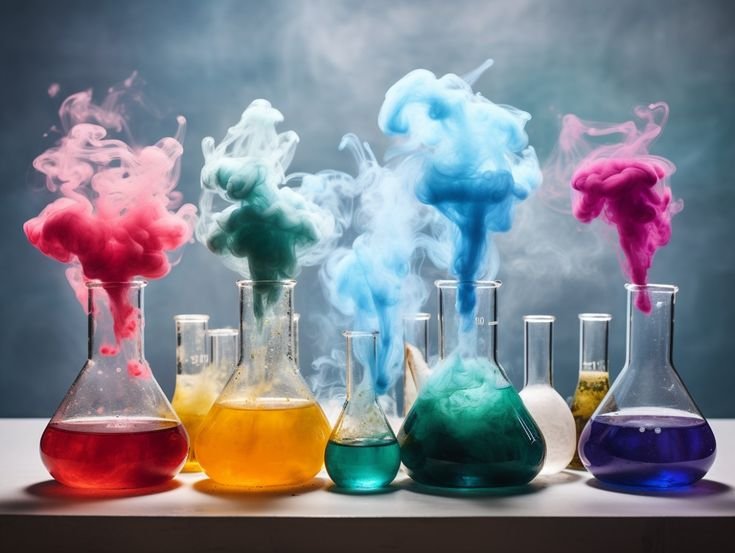
⚛️ Basic Concepts in Chemistry
Atoms and Molecules
- An atom is the smallest unit of an element.
- A molecule is formed when two or more atoms combine.
Example: Water (H₂O) is made of hydrogen and oxygen atoms.
Elements and Compounds
- An element is a pure substance made of only one type of atom (e.g., oxygen, gold).
- A compound is formed when two or more elements chemically combine (e.g., water, carbon dioxide).
States of Matter
Matter exists in three main states:
- Solid (fixed shape and volume)
- Liquid (fixed volume, no fixed shape)
- Gas (no fixed shape or volume)
⚗️ Chemical Reactions
A chemical reaction is a process in which substances (reactants) change into new substances (products).
Example:
Hydrogen + Oxygen → Water
Signs of a chemical reaction:
- Change in color
- Formation of gas
- Change in temperature
- Formation of a precipitate
🧫 Laboratory Equipment
Some common tools used in chemistry labs include:
- Test tubes – for small experiments
- Beakers – for mixing and heating liquids
- Bunsen burner – for heating substances
- Measuring cylinder – for measuring liquids
- Pipette – for transferring small amounts of liquid
🌱 Importance of Chemistry in Daily Life
Chemistry plays a very important role in our everyday life:
- Medicine: Helps in making drugs and vaccines
- Agriculture: Fertilizers and pesticides improve crop yield
- Food: Preservatives and additives keep food fresh
- Environment: Helps control pollution and treat waste
- Industry: Used in making plastics, soaps, detergents, and fuels
Safety in Chemistry Lab
- Always wear a lab coat and safety goggles
- Do not taste or directly smell chemicals
- Handle acids and flames carefully
- Follow teacher’s instructions strictly
- Ensure safety
- Have a proper lab
- Proper arrangement